
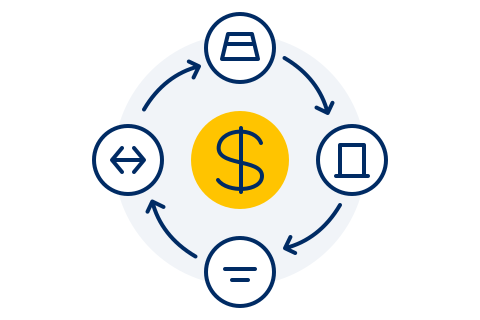
A business can be busy, make sales, and still run out of cash.
This happens when the timing of money coming in does not match the timing of money going out. You may complete a job today but only get paid in 30 days. Meanwhile, rent, wages, stock and supplier bills may need to be paid now.
Understanding this gap, between making a sale and having cash available, is one of the most important money skills a business owner can build.
Sales and cash are not the same thing
A sale is when you provide a product or service. Cash is the money actually available in your account to use.
If a customer has not paid yet, the sale may be recorded on your invoice, but the cash is not in your hands. That means you cannot use it to pay rent, wages or stock.
Definition
Cash flow
Cash flow is the movement of money into and out of your business over time. Positive cash flow means more money is coming in than going out. Negative cash flow means the opposite.
Definition
Accounts receivable
Accounts receivable is money customers owe you for work already done or goods already delivered. It is income you expect, but not cash you can spend yet.
A busy month with empty pockets
You run a small construction repair business. In one week you complete three jobs worth R42,000 and invoice each client with 30-day payment terms.
That same week you pay R8,000 for materials, R3,500 for fuel and R6,000 in wages. Rent of R5,000 is also due.
Why cash flow pressure builds
Cash flow problems rarely appear overnight. They build when money going out runs ahead of money coming in.
Common triggers include customers paying late, long payment terms from larger clients, buying stock before you sell it, paying suppliers before customers pay you, taking on a big job with upfront costs, spending expected income before it arrives, taking too much money out of the business, or facing large unplanned expenses.
| What you might see | What is actually happening |
|---|---|
| Strong sales on your invoice list | Customers have not paid yet |
| Healthy bank balance today | Large bills are due before income arrives |
| A big new contract won | Upfront material and labour costs must be funded first |
| Expected payment next month | Rent and wages are due this week |
A simple example: the gap between sale and payment
You win a R30,000 job. That sounds like a good month.
But before the client pays, you need to spend R12,000 on materials, R3,000 on transport and R5,000 on labour. The client pays in 30 days.
For those 30 days, the business must carry R20,000 in costs without the income. If another bill arrives during that period, rent, insurance, a vehicle repair, the pressure grows quickly.
This is why sales can grow while cash becomes tight. The business is doing more work, but the money has not caught up yet.
Protect your cash flow
Good cash flow habits reduce the gap between spending and receiving.
Ask for deposits where appropriate, especially on larger jobs. Confirm payment terms before accepting work. Invoice quickly and follow up on unpaid invoices promptly. Avoid spending money that has not arrived. Keep some cash aside for slow periods. Plan big costs before you commit to them.
Asking for a deposit
A new client wants you to supply and install custom shelving worth R18,000. Materials alone cost R7,500 and must be ordered upfront.
You ask for a 40% deposit before ordering. The client agrees and pays R7,200 before work begins.
Track when money moves, not just how much
A simple cash flow view tracks four things: when customers are expected to pay, when suppliers must be paid, when fixed costs like rent and wages are due, and what money is already available.
You do not need complex software. A notebook or spreadsheet with dates and amounts is enough to start.
Review this every week, not only at month-end. Cash problems show up in days, not months.
A common mistake
Planning spending based on invoices issued instead of money actually received.
An invoice is a request for payment, not a deposit in your account. If you commit to stock, wages or equipment based on what customers owe you, a delayed payment can leave the business short, even when sales look healthy on paper.
Your next step
List every payment you expect to receive this month and every bill that must be paid, with dates. Compare the two lists and note any week where costs arrive before income.
Keep learning
The next topic is fixed costs and variable costs.
Understanding which costs stay the same and which rise with your workload helps you budget more accurately and price with confidence.